

I recently listened to Bart Hutchins’ interview on Odd Lots about his restaurant Butterworths. It’s a great conversation, but the part that really stuck with me was the French fries:
I think [French fries are] on the menu right now for twelve bucks an order. And I was looking at an old menu of mine from [2019], and…the same fries were on the menu for nine bucks in order…and realized that, like, if I wanted the same sort of margins on that nine dollars order fries that I have on my now twelve dollars order fries, they would actually be twenty five bucks
Restaurant prices have been increasing nonstop, driven in part by higher labor and food costs in a post-COVID world. But the restaurant model itself feels stuck in a spiral: menu prices tick up to cover higher costs, making dining out more and more expensive every year. Even with higher prices, restaurateurs have to fight to keep their establishments open despite what are often low single-digit net margins.
It got me thinking: A restaurant essentially bundles admission and food, which forces menu prices to cover everything from rent to credit card fees. Instead of putting everything on food, what if restaurants charged separately for the table?
A brief primer on restaurant economics
Restaurants are famously tough to run; 42% of operators in 2025 said that their restaurants were not profitable.
A typical restaurant P&L is roughly a third of revenue on ingredients, a third on labor, and another 25%-30% across rent, insurance, marketing, credit card fees, and everything else. High-margin alcohol ends up playing a critical role in keeping most restaurants solvent.
To understand how restaurants stay in business, you need to understand Revenue Per Available Seat Hour, or RevPASH. Coined in 1998 by Sheryl Kimes at Cornell University, RevPASH is calculated as:

RevPASH makes a subtle point explicit: restaurants aren’t just constrained by the amount of food served, or the average order value (although both are important). Seat-hours dictate everything at restaurants; if you can’t sit someone, it doesn’t matter how high menu prices are. Any unused seat hour has an explicit opportunity cost, because the rent, staff, lights, everything is still running whether anyone is sitting there or not.
With capped space at prime hours, this incentivizes fast service to turn over seats, crowded restaurants, higher F&B prices, and a heavy push for alcohol. But all of this lacks predictability. If a dinner party skips appetizers and drinks, a table’s revenue can drop by 50% or more.
We could try something different.
An unbundled restaurant
Imagine a restaurant that charges $25 for an entree, $15 for a drink, and $10 for an appetizer. For a two-person table, let’s call a standard bill $90 — $50 for two entrees, $30 for two drinks, and $10 for an appetizer.
At standard restaurant margins, only about $27 of that $90 is actual ingredient costs. Instead of capturing that remaining $63 in the price of the food, a restaurant could institute a two-part pricing scheme.
First, you would be charged $25 per seat per hour — this covers labor costs and fixed costs for the meal. In exchange, you’re treated to a menu that takes you back to 2009: entrees that are $12 each, appetizers for $8, desserts for $6, and cocktails for an unheard-of $8 each. If you stay past your hour, you can pay a small surcharge for 15 minute increments; enough to keep things fair, not enough to create too much anxiety.
The economics on a table looks totally different; if we assume ~60% labor and overhead costs on our $90 order, it requires multiple dishes and/or an alcohol order for the traditional model to match the profitability of the table fee order. The restaurant still wants you to order, but no longer needs you to buy four cocktails to make rent.
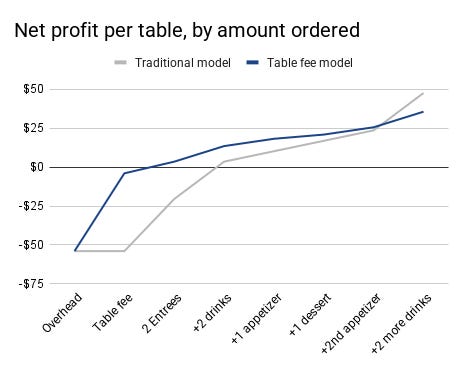
There’s a lot of logic to this. Behavioral economics research has demonstrated a pain of paying that comes from high prices — by the time you’ve mentally ordered $50 of food, a second drink feels extra indulgent. While an upfront payment hurts, each additional order feels particularly small and easy to justify.
Even better, the pricing structure creates a sunk-cost fallacy; if you’ve already paid $25 to be there, then it feels dumb not to take advantage of the cheap cocktails. Customers will try to amortize the upfront fee into lots of consumption in as little time as possible.
This structure might legitimately increase RevPASH while feeling like a deal. Our hypothetical couple ordering the same meal would pay $50 for their seats, $32 for their food, and $16 for their drinks — a total of $98, almost 10% more than under a pure ordering situation. Even if you lowered the entry cost to $21 to keep the total bill flat, the lower variable prices would almost certainly drive up purchasing. I’d definitely grab a second drink, and maybe dessert.
There is one catch though: the servers’ tip base just collapsed. We already live in a world of complex tip norms; do you tip on the table or just marginal spend? A 20% gratuity on food means that tips decline nearly 50% if you exclude the table.
This dynamic probably limits the restaurant types this will work with; customers will resist tipping on a flat fee, but cutting tips 50% will make it impossible to retain talent. In practice, this model probably only works if you fold service into the table fee. This isn’t guaranteed to work — most no-tip experiments have failed — but perhaps a hybrid model with lower tips but higher table-supported wages can manage to operate.
You’d need to design a restaurant to leverage this
Today, restaurants have to optimize for turn time — how fast they get you in and out. A table needs to constantly add to their tab to keep RevPASH sustainable; at the same time, speed in the kitchen and bar is paramount. A busy restaurant runs like a well-oiled machine, with a rhythm that brings consistency and turnover. Restaurants fight to balance getting customers out with not making them feel rushed (a fast track to bad reviews).
Does that change if there’s a seating fee and lower prices? It’s mostly demand dependent; restaurants benefit from getting you out before your paid hour is up if they have someone waiting on the table, but don’t care if there isn’t. Either way, once you’re paying time surcharges, both the restaurant and the diner begin to internalize the cost of occupancy, a big improvement from today.
The menu probably needs to shift to adapt to a world of cheaper dishes. Driving impulsive buys becomes the game; lots of small plates and appetizers designed to trigger a “why not” reaction, sort of like an Izakaya or Tapas. This extends to the kitchen, where speed to output becomes increasingly important — you want your customers to finish their plate so they can order another.
To make this work operationally, the whole restaurant needs to be designed to facilitate ordering. QR codes are sort of lame, but why not put big menus on the walls? A way to place orders quickly is key — tablets won’t work for fine dining, but perhaps a table button that pings your waiter. It’s important to be transparent with customers and let them know how much they’re spending; a clock on the table seems justifiable, but might bring the mood down a bit.
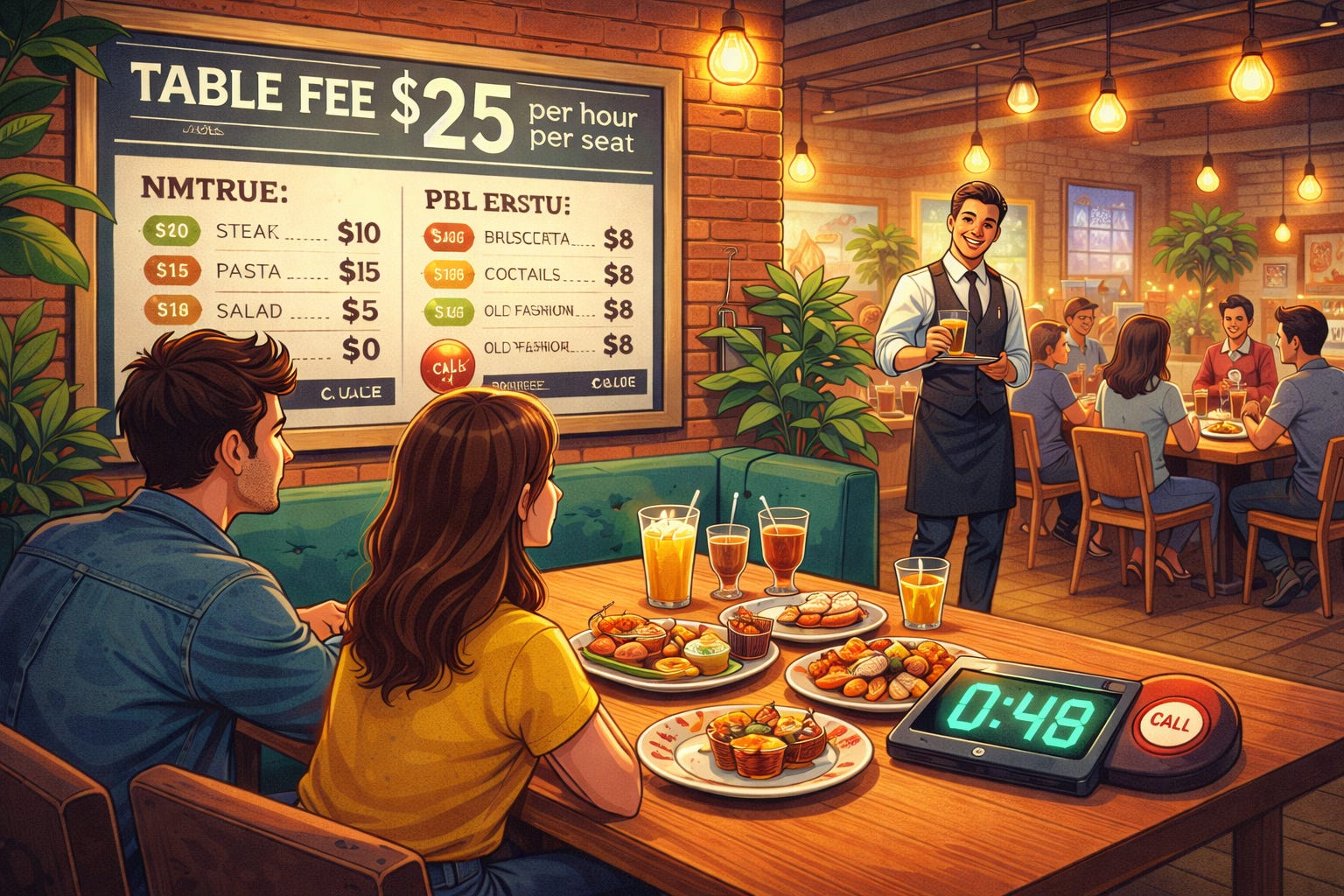
This is essentially Costco as a restaurant. You’re not paying for food — you’re paying for access to high-quality goods at low prices. The fee is the business, the dishes are just a bonus to get you in. Go browse and enjoy the dopamine of bulk goods and low prices.
Table management opens some new possibilities
It’s critical to keep tables full to make the most out of this system. That’s where dynamic table pricing comes in; instead of giving happy hour discounts on specific dishes, the hourly table price shifts to maximize occupancy over the course of the day. As restaurants get more data, they can develop software to dynamically adjust daytime pricing to maximize profit.
This does more than keep tables full: it creates optionality. Restaurants have massive amounts of off-time that they struggle to monetize. What if during off-peak hours, they dropped the fee to $10/seat with a skeleton crew and a menu focused on coffee and snacks? Bam, you’ve just turned your empty dining room into a WeWork during the 2pm-5pm weekday lull.
Dynamic fees open up other opportunities. If there’s a long line, it only makes sense to turn the waiting list into an open auction. The people willing to pay higher table fees can go to the front and be seated sooner; with an active “next seat” price, people can make intelligent tradeoffs about deciding to wait, paying an extra $25 per person, or going somewhere else.
The signaling power of the open auction could build real buzz. High prices to be seated early show high demand for the restaurant, a flex for those who want to see and be seen. Given that the old “slip the host a $20 to get seated early” has evolved into complex reservation resale markets, the transparency could be a nice change of pace.
But timing could cause problems
The timing dynamics raise some game theory issues. Once you’re charging for time, the restaurant does have some incentive to slow-walk dinner. If a table is on the cusp of their time limit, maybe food runs slow down a little bit. If the kitchen slow-walks the dessert, you might be able to pitch an extra glass of wine. The bill comes one minute late and triggers a second surcharge. Every minute at the table after a certain point actually makes the restaurant money.
Would restaurants actually begin to slow down to monetize time? In some ways, it doesn’t matter if they do — customers will understand it’s a possibility, and a preemptive reaction will change the dining experience.
The possibility of being cheated is going to be in the back of everyone’s mind; the bartender taking a long time to get the drinks goes from a mild annoyance to paranoia fuel for a customer afraid of being ripped off. The waiter not acknowledging your little check please hand gesture is going to feel a little more malicious.
Given this risk, building trust is key. Items might start to come with delivery estimates, with time extensions if your cocktail doesn’t make it to you in the 8 minute SLA. Kitchen delays might correspond with credits for more food, a slightly more formal version of a “we’re sorry” free dessert. No matter what the incentives, speediness is paramount — especially when trying to pay. Please, don’t make me wait and do the awkward check please thing.
Official idea rating
4/5. I don’t think this can possibly be the answer for every restaurant out there; it’s a little too different from how the industry has worked for the last few decades, and it relies on being a reasonably desirable restaurant. But the economic logic makes sense; I’d happily pay a two-part tariff for a date night, and I’m sort of annoyed that I can’t after writing this.
One of the biggest barriers to restaurants trying novel pricing structures is fear of customer backlash; Sheryl Kimes found that charging for reservations was viewed in a positive light among people familiar with the practice, but those who aren’t found any version of it unfair. The hardest part is being the first mover; maybe a small-plates, alcohol-forward Izakaya with a chef that’s into economics.
If nothing else, the weird pricing structure is sure to generate its own PR when Bart Hutchins can go back to $8 for fries.
Like seemingly all good economic ideas, David Friedman was early on it: https://daviddfriedman.substack.com/p/restaurant-puzzle
Also lol you just reinvented Korean restaurants.