

I spent most of last week watching the first season of The Pitt. It hit me around hour 6 that I was watching a lot of ads — by my count, about 16 per hour-long episode.
It wasn’t always this way.
In the early streaming days, ad-free viewing was one of the most compelling value props. But a combination of increased competition, higher licensing fees, and market saturation squeezed profit margins while limiting price increases. In response, streaming platforms introduced lower-cost but ad-supported plans by the early 2020s. Very quickly, ad-supported plans became the default as a tool to keep headline prices down.
I don’t mind seeing ads sometimes, which is why I don’t pay for the ad-free plan. But it does drive me crazy when I get a totally irrelevant, annoying ad. It got me thinking: what if I could pay a nominal fee to skip the ads I hate?
The economic argument for pricing ads
Most modern streaming platforms have both ad-supported and ad-free tiers. This setup is actually a sophisticated form of price discrimination, letting streamers raise prices on their traditional plans while providing an ad-powered release valve for price-sensitive customers.
But it’s not just about stopping budget-conscious viewers from canceling or reaching new markets. Surprisingly, ad-supported plans can be more valuable per user than ad-free subscriptions. The reported CPM (cost per thousand impressions) for streaming ads can be $30 or more, meaning platforms earn $0.03+ each time they show an ad to a viewer.1
Given an average user watches a surprisingly high 60 hours of Netflix a month, adding ads in can be extremely lucrative. Assuming 10 ads per hour, an ad-supported user paying $7.99 per month generates $26 in revenue vs an ad-free premium price of $17. It makes total sense that ad-supported plans took over the market!
But no streamer, to my knowledge, is thinking about the “sometimes-ad” watchers. This viewer doesn’t mind ads overall, but they do get annoyed at particularly obnoxious or repetitive content. There’s probably a willingness to pay to avoid the marginal annoyance of watching that specific ad, but today nobody is capturing it.
Doing so would be simpler than it sounds.
How pay to skip works
A pay to skip system is relatively simple. If you’re on an ad-supported plan, you continue to get ads exactly as you always have been. The only difference is that alongside each ad, there’s a clear “pay to skip” button, with a dynamically set price listed alongside. Paying to skip doesn’t replace the ad: if you have 3 ads and skip the first one, you only have to watch two more.2
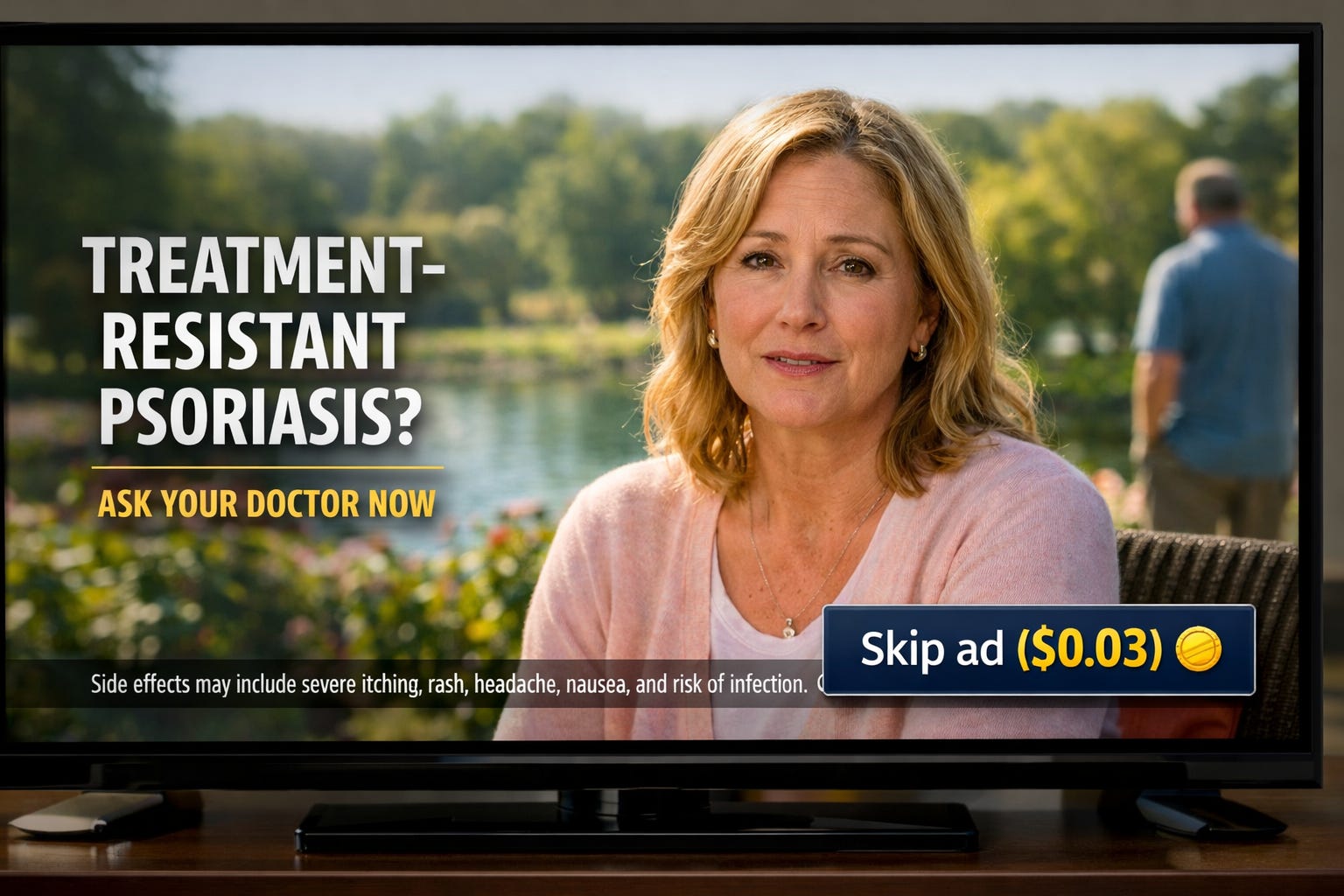
Pay to skip does more than monetize ad breaks. It provides valuable negative targeting data on what users don’t want to see. Platforms have attempted to get this — I sometimes get “did you like this ad” questions — but without the ability to skip it, there’s not much reason to engage. The combination of a skip and a price creates an extremely strong “I don’t want to see this” signal.
Not only does this give advertisers new targeting tools — i.e. excluding me after I spent $1.20 skipping the home-auto insurance ad for the 40th time — it gives platforms data they can’t directly get today. Better data for streamers means improved targeting, higher prices for impressions, and attracting more inventory and ad diversity.
It’s not quite the information density that Tiktok or Facebook can offer, but negative targeting would bring streamers a bit closer.
Allocating the skip fee
Netflix has roughly 190 million ad-tier viewers who watch at least 1 minute of ads a month. If we assume they skip 5% of ads, that’s an additional $2b in annual revenue for Netflix alone. Who gets the money?
One approach would be to treat it like a full refund: if someone opts to skip an ad, the impression is free for the advertiser. The price of skipping the ad would have to match the price the advertiser paid to show it to them, say $0.03 on average.
But arguably, streamers don’t have to give a full refund. Given somebody paid to skip the ad, the advertiser was probably not getting much value from showing it to them. At least they’ll save money not retargeting that person in the future.
Streamers have a decent case for keeping most of the skip fee. A mix of privacy regulations, tracking changes on mobile devices, and fragmented platforms means that targeting can be more difficult today than it was 10 years ago. Given that a pay-to-skip is meaningful data on consumer behavior, streamers could credibly claim that the transaction is a net-positive impact for the ad-buyer. If advertisers’ value per impression stays broadly the same, there’s not much downside for ad buyers.
Over time, this data would bifurcate ad-tier users between low signal (doesn’t skip) and high signal (skips strategically) users. The high signal group will get increasingly targeted ads, which can command a higher price from ad-buyers that know they’re a valuable impression. Worst case scenario, they’ll skip all of their ads, somehow spend more than just going ad free, and become cash cows for Netflix.
The opposite happens for the low-signal group. By selecting out the least targeted users, price per impression for this group would fall and bring in lower quality ads. The end result would be an unofficial garbage tier of advertising inventory, with online crypto casinos competing with whole life insurance plans for the least qualified viewers.
What does this mean for the streaming industry?
While I’d be happy to skip individual ads, this setup would create a huge amount of moral hazard. Netflix might, theoretically, collect a fee to show the ad and a few cents to skip it and the data for resale. In the short term, it could be more profitable to intentionally show low-quality ads that drive skips.
Of course, they’ll want to keep their advertisers happy, so anti-targeting is probably out. But it would be totally logical for Hulu to make 10% of ads actively annoying or irrelevant to generate skips dynamically. Some entrepreneur could even build a studio designed to annoy users as much as possible, collecting a small fee from Netflix for being so bad that people have to skip.
The biggest risk is that double monetization drives a proliferation of ads. Ad-free tiers will probably increase in price in an attempt to push more people to the increasingly profitable ad tier, supported by a variable payment for skipped ads. At an extreme, platforms have the option to make ad-free tiers outrageously expensive, moving towards a microtransaction model to avoid ads — think “watch the Game of Thrones finale ad-free for only $0.50.”
At least it’ll incentivize funding entertainment that’s high enough quality to justify the microtransactions. Sopranos revival here we come.
Or, the entire model could change
Implementing this model is easier to imagine for ads, but streaming platforms don’t HAVE to sell their ad inventory to brands. If they have a strong price based feedback mechanism, why couldn’t they pivot fully into data collection?
This already exists in small doses — some platforms will ask you whether you want to watch a Geico or Jeep ad, or whether you’d recommend Google Search to a friend. But we all know this is relatively low quality data; most people will just skip or choose the default choice to get through the interruption.
Instead, streamers could show content at various price points and see what sparks somebody to pay to skip it. Show videos of people eating gratuitously to find out who’s on a diet. Show aggressive political spots to find out partisan affiliation. Find out people’s phobias for some reason.
Collecting the right datasets could become more valuable than selling the ad space. Not only would streamers capture the cost to skip, they’d be able to sell the outputs to a range of market research, academic, and big data buyers.
While it might be profitable, there’s an open question whether data collection can coexist with traditional ads: is Kellogg ok with a Quaker Oats commercial next to an attempt to understand the psychology of The Pitt viewers? I’m not sure psychological interrogation as a service is the future of television, but given competitive pressures it might be worth a shot.
Official idea rating
3.5/5. There is a really strong logic in giving users high-signal ways to share whether an ad is relevant, and negative targeting is probably underused in entertainment. It seems almost inevitable that some platform will adopt a version of limited ad skips in the next few years. The big jump is being the first one to charge for it; the first adopter will get some negative press, but if they lived through the introduction of ads they can probably live through this.
But the moral hazard will probably keep more aggressive implementation at bay. Ad buyers would have concerns over when their ads are shown, streamers risk devaluing ad prices for some of their users, and end-users are likely to see it as exploitative. Even in the streaming era, entertainment distribution can be a conservative industry.
Still, I’m holding out hope that I’ll be able to give feedback on my ad targeting sooner rather than later. My dream is that one day I can directly tell HBO that I do not have psoriasis, am not buying a car, and haven’t been “back to school” in quite some time.
I’ve seen CPM ranges for HBO Max range from $20-$50 — if you happen to be an ad buyer for streaming platforms, let us know what you see in practice.
Micropayments on a television seem like a huge pain. To make this seamless, the plans could keep a $5 refundable deposit. This deposit funds ad skips, is topped off at your next payment, and any remainder is refunded if you cancel. The deposit can be adjusted based on actual usage data over time, or allow for mid-month top-offs to maintain a balance.
Love this— the one I really hate is when they run the exact same ad over and over. In a lateral thought this from New York’s water department: “
NYC saw a significant reduction in water usage throughout the five boroughs during the Super Bowl’s [Bad Bunny] halftime show yesterday. In the 15 minutes right after the show ended, there was a spike in usage equivalent to 761,719 toilets flushing across town.”
Hey now! Whole life is actually not as shitty as term. Term is a LOT easier for fly-by-night scammers to skip out on.